

Buy the server, rent the GPUs
Clouds overcharge for the boring server, retail overcharges for the GPUs. So I self-host Era's backend on a hand-me-down Xeon and rent the inference. The actual 2026 numbers, plus the recommendations to get started building.
The ideas here are mine - AI helps edit and sharpen the writing, and I do the final pass.
*First post so quick intro. I’m a staff engineer at Uber, and on the side I run Erasmus Labs where I build consumer AI products solo with coding agents. eg. Era, is age-adapted picture stories read in a parent’s own voice, running in production on a machine in my house. I’m just going to write up what I learn building these stuff, with the actual numbers, from actual builder, not influencer perspective. My intention to give back to the community and sharing knowledge, nothing withheld (other than confidential info), no paywall, no ads. Personal opinions you might or might not agree with. Probably once a week.
Upfront AI usage disclosure - Content and everything is from me, AI help to sharpen them, I do the final pass of edit manually.*
The advent of agentic coding has been exhilarating. It’s like giving builders a superpower - You can build almost anything you can think of. We will get to the software part in another post. In this post we will talk about the initial setup and how to unlock what you need to build and deploy frictionlessly.
Era needed a backend. Anything with logins or user accounts does, or anything where you want to change the logic without shipping a new app build. You can build apps to live without a backend, but it places limit on what you can build.
The default now is to rent all of that - Vercel for hosting, Supabase for the db, some subscription for each extra thing on top. That default has killed more of my side projects than any actual bug previously, because the moment there’s a meter running with zero users it changes how you build. Every feature becomes a question of what it costs. You start avoiding things. Eventually you just stop. At the end of the day it might not cost much, but every dollar is something you feel as you are building and adds friction to the process.
The numbers, as of July 2026: Vercel Pro is $20/user/mo, then $2 per million edge requests and $0.15/GB transfer once you’re over. Supabase Pro is $25/mo for 8GB of disk, then metered, $0.09/GB egress, compute add-ons from $10 up to $3,730/mo. There are free tiers but they’re built to push you off them - Supabase pauses a free project after a week idle, and a side project is idle basically all the time.
The thing is, you’re not really paying for compute there. Raw AWS or GCP isn’t even that bad. You’re paying to not do the ops yourself. And that’s the exact part that got cheap this year - I have an agent write the Docker setup, the Postgres database etc in a couple of hours, or maybe even less than an hour, on my own server. The whole reason those subscriptions exist is basically free now.
So for Era I just did the opposite. And once you look at this year’s prices it’s kind of obvious: the clouds overcharge for the boring server, and retail overcharges for the GPUs.
The server’s the easy part, and mine wasn’t even really a purchase. It’s a 10 year old hand-me-down dual Xeon workstation with 128GB of DDR4 ECC. Look the same model up on eBay and there’s a ton of them going cheap (less than $500) - it’s decommissioned server stock, companies dump these constantly. Here’s something interesting: regular old DDR4 has gotten kind of expensive, with DDR5 prices astronomical, but the ECC server version is cheap, because there’s so much disposed server memory floating around, and it can’t be used on a regular non-server machine. So you get a real server CPU, a server board and a pile of ECC RAM for less than a mid consumer desktop, and it’s actually sturdier than one - ECC means a flipped memory bit doesn’t silently corrupt something or take the box down, which for a machine running 24/7 in a closet does matter. A regular PC would do the job as well if you have one, just install linux on it.
Storage is where I actually spent money. A 4TB SSD, which is a painful $500 in today’s SSD market, plus another $200+ for a 12TB HDD to back it all up. Sounds like a lot, but it’s still well under what Apple wants to take a Mac up to 4TB, and unlike the Mac you don’t have to commit up front - start with a 1TB SSD and add more when you actually need it.
Whatever the box is, it replaces the whole managed stack. Sits in my house, serves every Era request, and I can throw any dumb idea at it for free other than electricity cost. The rest of the cloud bill is basically nothing - Cloudflare Tunnel gets traffic to it with no open ports, free on every plan, and R2 holds the data blobs at $0.015/GB-mo with no egress fees, first 10GB free. So my actual recurring cost is electricity, and a box like this barely use much even on Bay Area rates.
GPUs are the opposite. Prices right now, from me actually trying to buy them: a 5090 is $1,999 MSRP but it’s as impossible as trying to get a Patek Phillipe Aquanaut at MSRP. Current price I’m seeing is around $3,999.99 for one. Build a box around one and you’re at $5-6k for 32GB of VRAM and 1TB SSD. The RTX Pro 6000 was $8,000 when I almost pulled the trigger in February 2026. I didn’t. It’s around $11,999.99 now. Up 50% in five months. And you want 100+ GB of system RAM next to it as well (rough rule, match the 96GB of VRAM so you can load the weights), so realistically it’s a $15,000 machine.
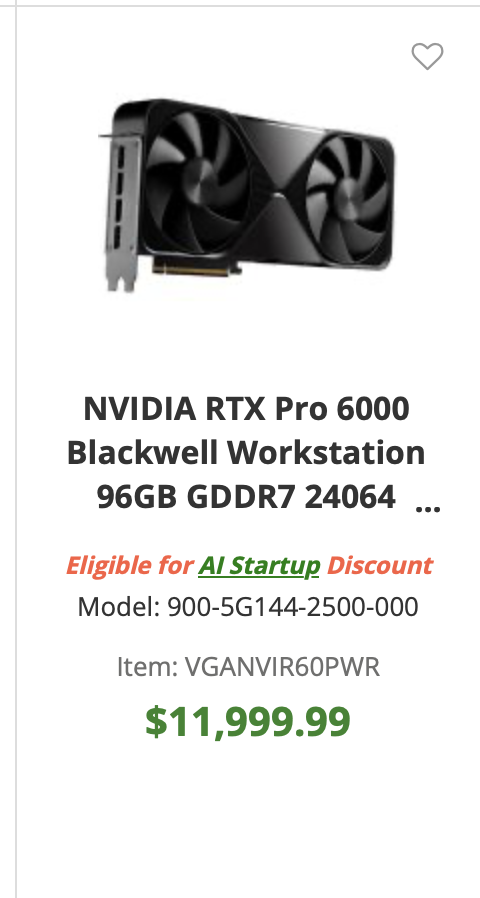
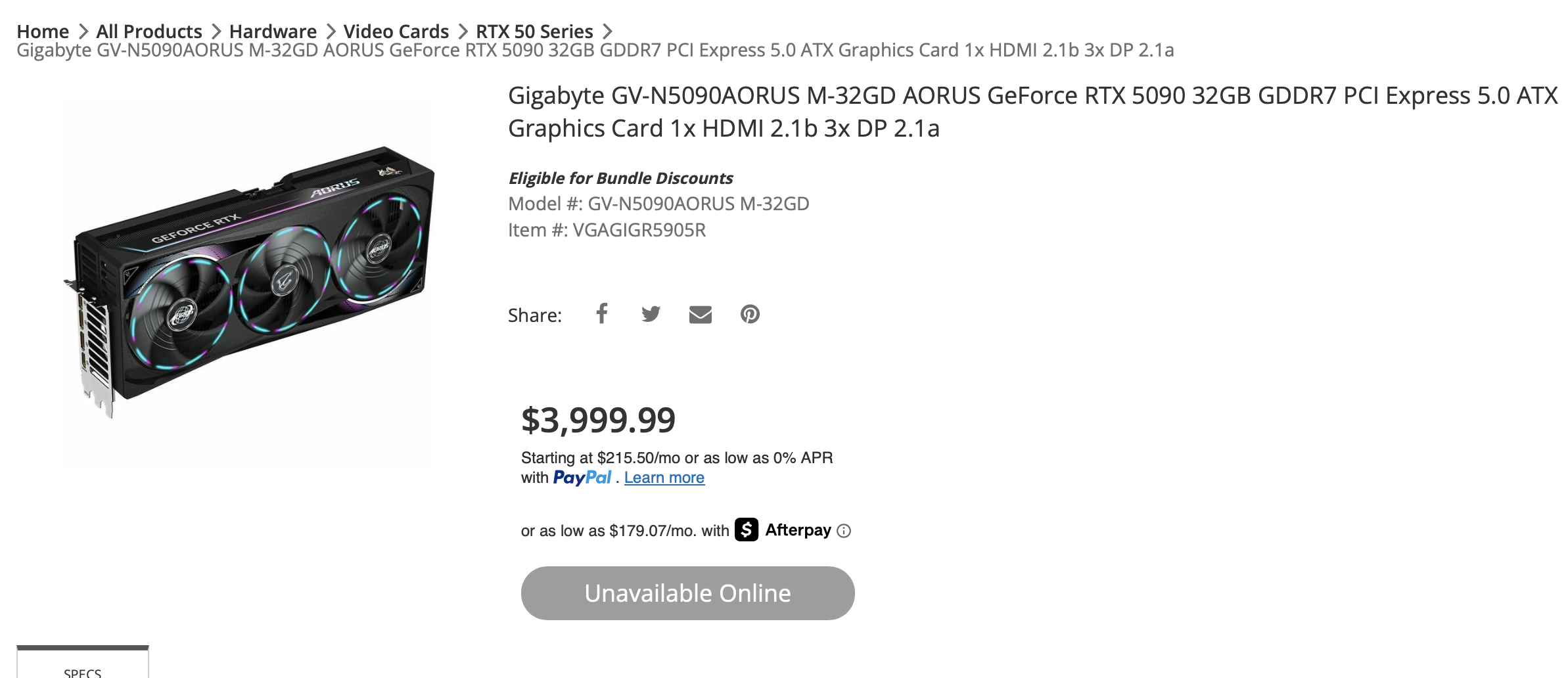
Both from Central Computer, 23 July. The 5090’s MSRP is supposed to be $1,999.
And $15k just buys the thing. It pulls close to a kilowatt under load, the 600W card plus everything around it, and running that 24/7 on Bay Area power - PG&E is about the most expensive in the country - is another ~[$300]/mo before a single user shows up. Rent it and the power’s in the hourly rate. Own it and it’s your problem.
For GPU cloud, RunPod or other neo clouds rents the same 96GB card two ways. Serverless, which is what one of Crucible’s endpoints runs on, is $3.49/hr but billed by the millisecond - you pay for the seconds a request actually runs and nothing else. A day with a handful of generations costs cents. That’s what a zero-user product should be on. Which is why you can’t take $15k, divide by $3.49 and call it six months - nobody runs a per-millisecond serverless endpoint flat out 24/7, that’s not what it’s for.
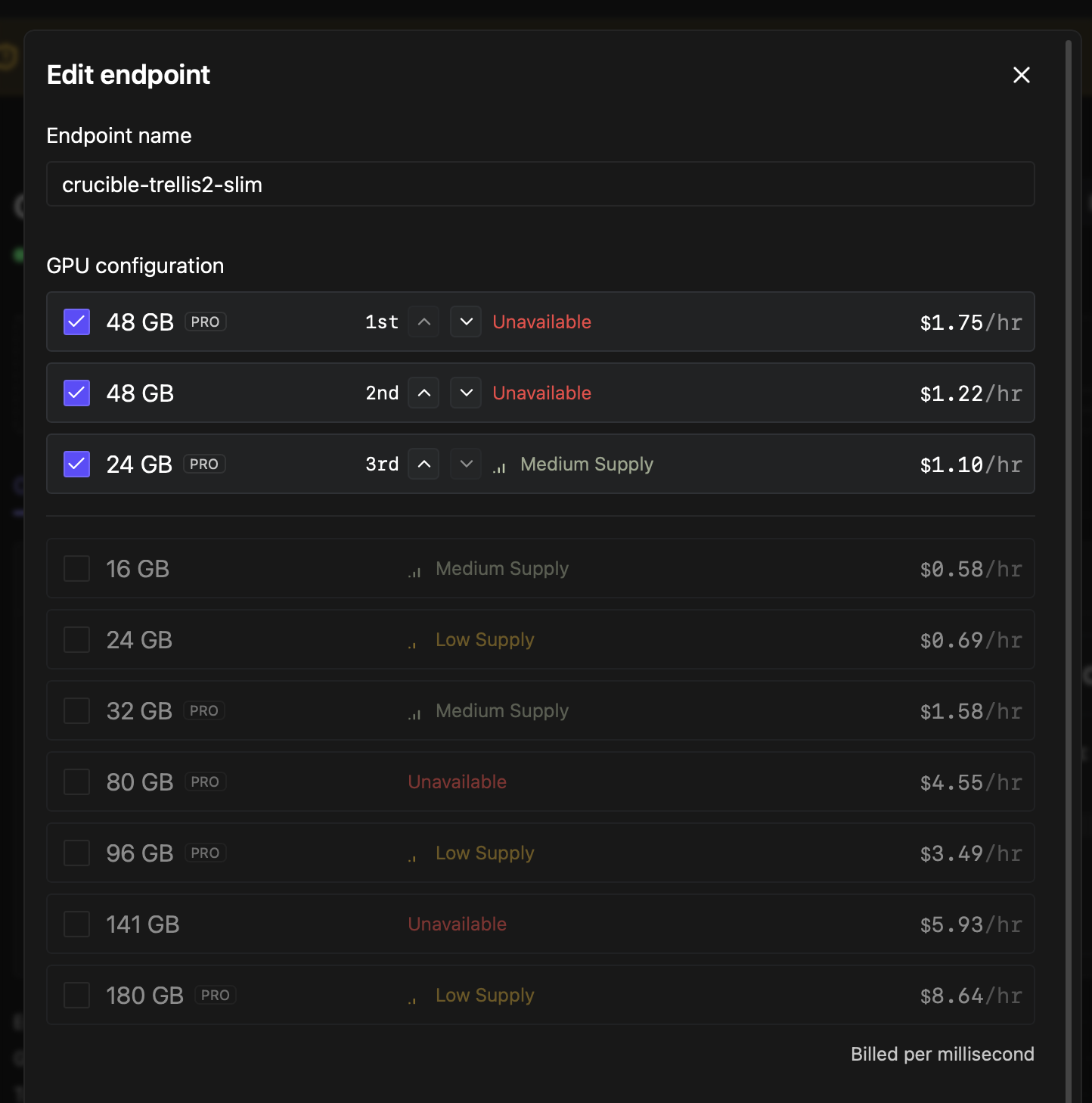
One of Crucible’s endpoints. 96GB row is $3.49/hr, and “billed per millisecond” down in the corner.
The real 24/7 rate is a dedicated pod, about half - same Pro 6000 at $1.69/hr community, $1.99 secure. That’s the number you’d actually hold up against buying. This is something you would want if you are training a model over hours/days. At $1.99 a $15k build is something like ten months of nonstop load before owning wins, and you won’t be running nonstop until you have real traction, and by then you actually know your usage instead of guessing at it. Until then you’re on serverless and it just follows demand, which early on is close to zero.
Anyway - own the server, rent the GPUs. Backend at home from day one, inference on serverless until your own numbers say otherwise. And if you ever hit the point where you genuinely need 99.99% uptime, the cloud bill isn’t going to be a problem at that point anyway. The main point of hosting locally is removing all frictions to just building. Having a cheaper owned GPU do help at this point as well, which is why I still have a DGX Spark sitting next to my server for light training and model testing.
Now, Era’s actual inference, at least the voice models - doesn’t run on a rental. It’s on a DGX Spark sitting right next to the server. A Spark is cheap and purpose-built, a genuinely different bet than a $15k Pro 6000 box, and it’s worth its own post - what it’s good at, where it falls over. Soon.
Couple of caveats, on my setup:
- your internet and your power are production now. get a battery for the server and the router, couple hundred bucks, just do it.
- if your thing needs a frontier-scale LLM on every request, none of this owning-vs-renting stuff really applies, just call an API.
- going to be a separate post of it’s own as well, how you design the client app matters. Building the system in a way that a server outage still allow most happy path flow to work will make SLA part of the home serving less of an issue.
Discuss on X.
Sources, all 23 July 2026: RTX Pro 6000 96GB — $11,999.99, RTX 5090 32GB — $3,999.99, RunPod pricing, Vercel, Supabase, R2, Cloudflare Tunnel.